Apple MacBook Neo Review (2026): A $599 Mac That Punches Way Above Its Price
Apple's MacBook Neo starts at $599 — and somehow doesn't feel like a budget laptop. We benchmarked the A18 Pro chip against M1, M2, M3, and M4 to help you decide if it's the right Mac for you.
Overview
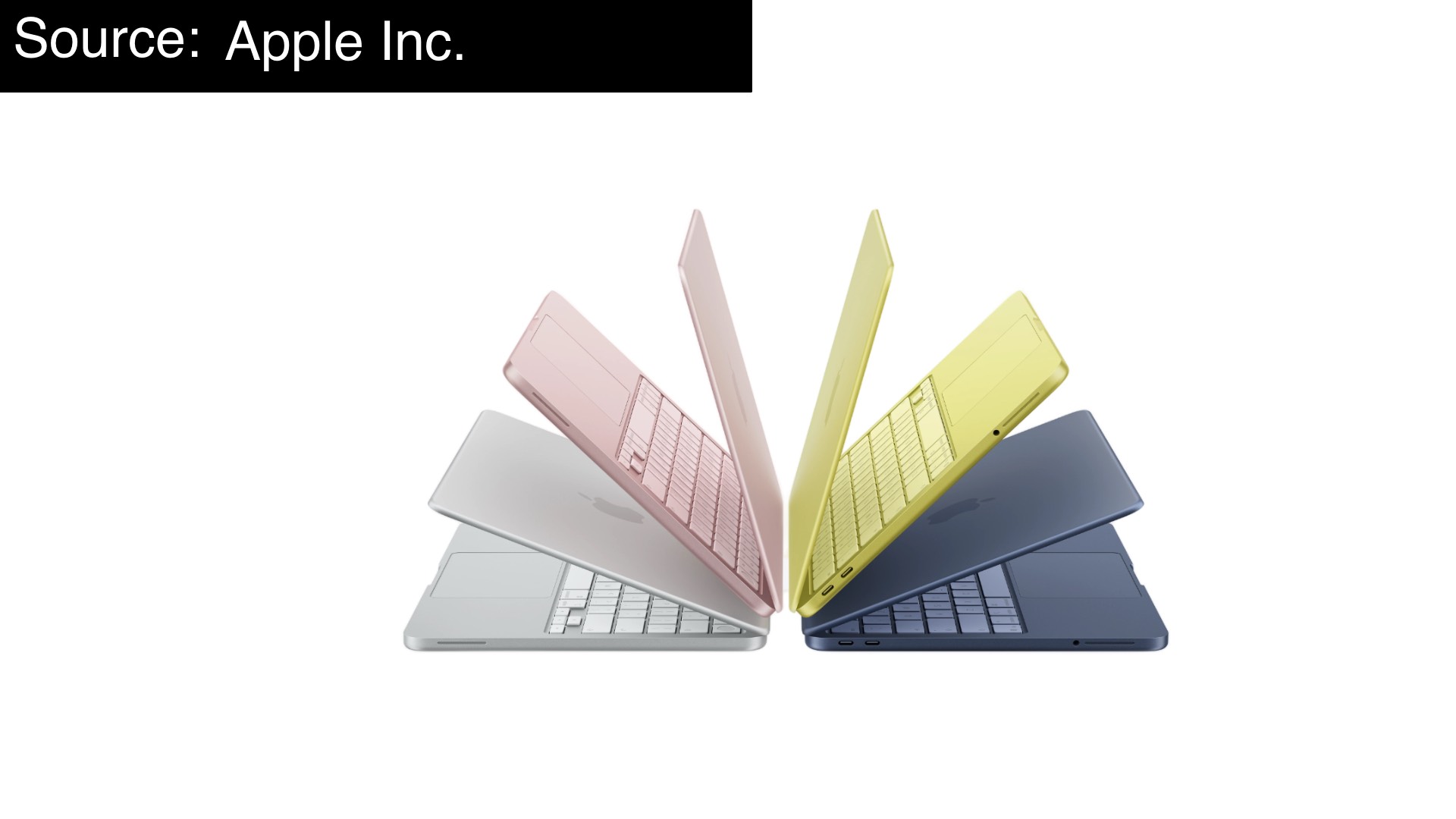
Apple has done something unexpected with the MacBook Neo — it built a laptop that starts at $599 (or $499 for students) and still manages to feel like a proper Mac. The Neo is the first MacBook to ship with an A-Series chip rather than an M-Series, powered by the same A18 Pro that debuted in the iPhone 16 Pro, albeit with one fewer GPU core. It's a bold bet, and for the most part, it pays off.
Design & Build
The MacBook Neo's industrial design follows Apple's familiar aluminum unibody formula. At this price point, Apple has made some compromises: the keyboard lacks backlighting, and the port selection — while functional — requires some adjustment in daily workflow. These are the sorts of trade-offs you'd expect at the $599 tier, but they're worth knowing upfront.
The A18 Pro Chip: Apple's Unusual Choice
Using a mobile A-Series chip in a Mac is a first for Apple. The A18 Pro is a 6-core CPU design, which differs notably from the 8-core layouts found in the M3 and M4 MacBook Airs. This core count difference is the key performance trade-off that prospective buyers need to understand before committing.
Geekbench 6 Benchmark Results
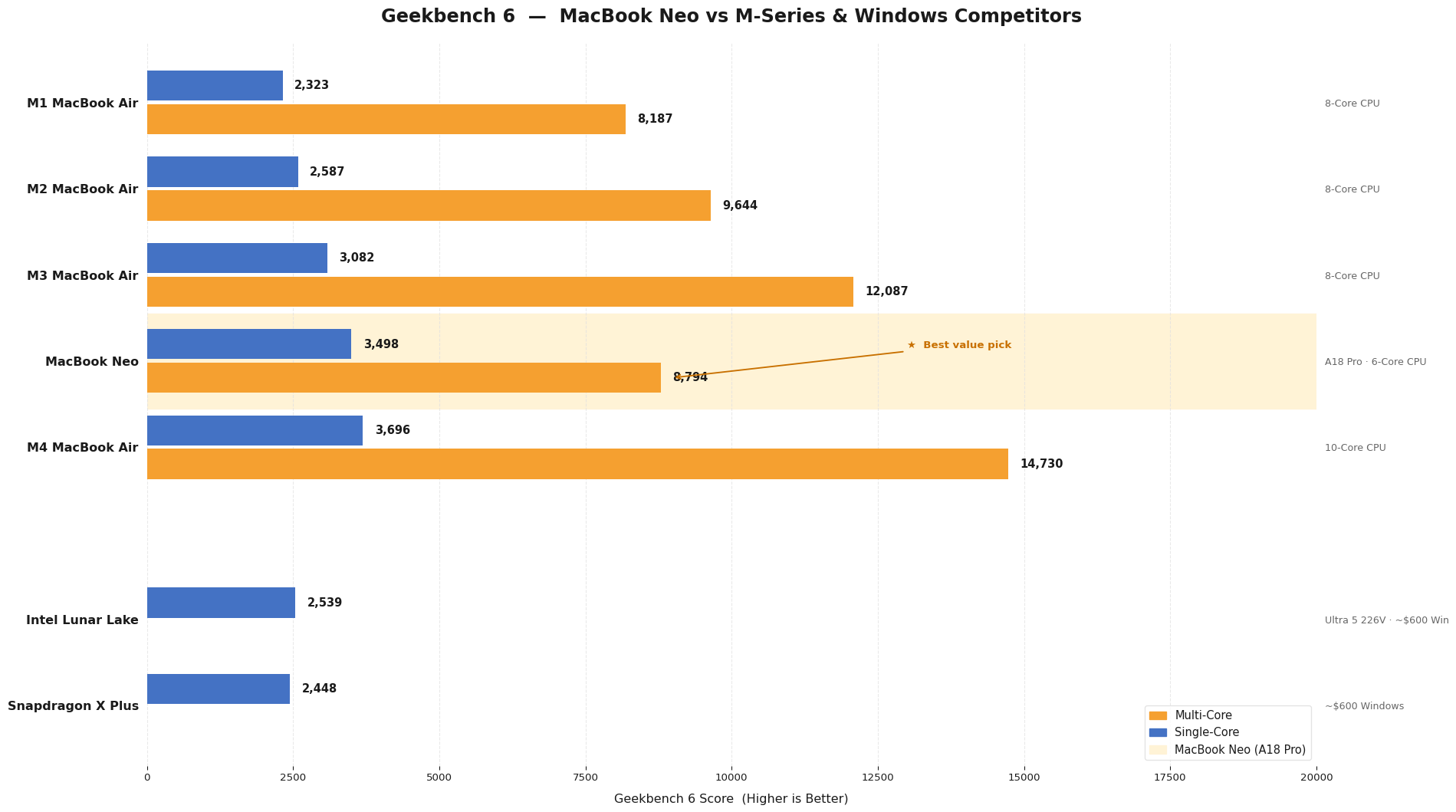
Scores vary slightly across benchmark runs and configurations.
Key Takeaways from the Numbers
Single-Core Performance is where the A18 Pro genuinely impresses. It beats the M1 by roughly 47%, surpasses the M2 and M3 outright, and lands within about 6–7% of the M4 — all at less than half the price of an M4 MacBook Air. For tasks like web browsing, writing, coding, and most productivity work that runs on a single thread, the Neo punches well above its weight.
Multi-Core Performance tells a different story. Because the A18 Pro uses a 6-core CPU while the M3 uses an 8-core layout, the Neo trails significantly in sustained multi-threaded workloads. The M3 MacBook Air scores around 12,087 multi-core versus the Neo's ~8,700 — a gap of roughly 39%. For video rendering, large compilation jobs, or anything that saturates all CPU cores, the Neo falls behind even the M1-era multi-core pack.
Against Windows Competition at the same price, the Neo is dominant. Its single-core score is 38% faster than Intel's Lunar Lake Ultra 5 226V and 43% faster than the Snapdragon X Plus found in competing $600 Windows laptops.
GPU Performance
The Metal GPU score of around 31,286 is solid for light creative work — photo editing, casual Lightroom use, and light video tasks all feel smooth. The iPhone 16 Pro scores slightly higher (~32,575) on Metal due to its extra GPU core, but the real-world difference is negligible for most users. This is not a machine for 3D rendering or gaming at high settings, but it handles the everyday creative workload comfortably.
Real-World Performance
In daily use, the MacBook Neo does not feel like a budget laptop. macOS Sequoia runs fluidly, app launch times are fast, and the machine stays cool and quiet under moderate loads. The 8GB of unified memory is sufficient for most users, though heavy multitasking with large files (4K video timelines, large Xcode projects) will surface its limits sooner than an M3 or M4 machine with 16GB.
Battery life, a perennial Mac strength, holds up well given the efficiency heritage of the A-series architecture.
Who Should Buy the MacBook Neo?
Great fit for:
- Students and first-time Mac buyers
- Everyday productivity users: browsing, writing, email, light coding
- Users upgrading from an Intel Mac or older M1 machine
- Anyone who wants macOS at the lowest possible price
Consider stepping up if:
- You do sustained video editing, 3D work, or large compilation tasks (the M3 Air's multi-core lead matters here)
- You need more than 8GB of RAM
- A backlit keyboard is non-negotiable for you
Verdict
The MacBook Neo is a genuine surprise. Apple has extracted impressive single-core performance from a mobile chip, packaged it in a proper Mac chassis, and sold it at a price the company hasn't touched in years. Its single-threaded speed embarrasses the M1 and M3 and comes within a hair of the M4 — all for $599.
The multi-core limitations are real, and buyers doing sustained heavy work will be better served by an M3 or M4 Air. But for the vast majority of users, those workloads never arrive, and the Neo will feel fast every single day.
For the money, it might be the most practical Mac Apple has ever made.
Score: 8.5 / 10