Dhurandhar: The Revenge — A Wildfire That Burns Bright but Not Always Clean
Ranveer Singh delivers a career-best performance in Aditya Dhar's 229-minute spy epic. But does the film's nationalist politics overshadow its storytelling? Read our full review.
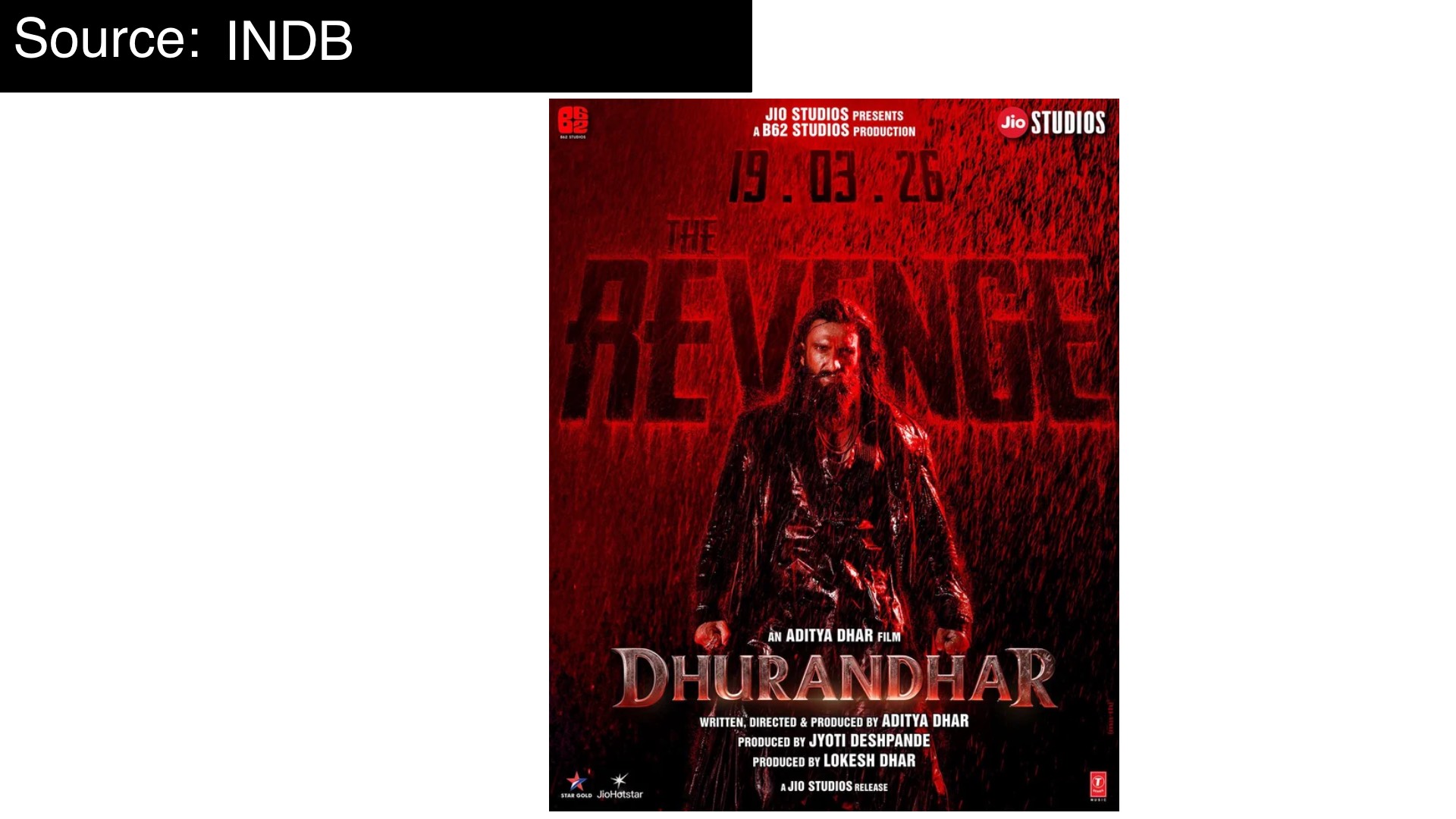
There is a scene early in Dhurandhar: The Revenge where Ranveer Singh's Jaskirat Singh Rangi now operating in the shadows of Karachi as Hamza Ali Mazari walks through a crowded bazaar, his eyes carrying the weight of a man who has buried everything he ever loved. No music. No dialogue. Just a face doing all the work. It is, quite simply, one of the finest pieces of screen acting Bollywood has produced in years. And it is in moments like these that Aditya Dhar's colossal, chaotic, contradictory sequel finds its soul even as it repeatedly risks losing it in a cacophony of explosions, chest-thumping patriotism, and a runtime of 229 minutes that makes it the eighth-longest Indian film ever produced.
Synopsis & Premise
Dhurandhar: The Revenge picks up where the 2025 original left off, escalating the stakes of its undercover espionage universe to near-mythic proportions. The film opens in the year 2000, with a young Jaskirat Singh Rangi from Pathankot leaving for military training only to return and find his world annihilated. A violent land dispute orchestrated by local MLA Sukhwinder Singh has cost him everything: his father is murdered, his elder sister is brutally assaulted and killed, and his younger sister Jasleen is abducted. Jaskirat, fueled by grief and rage, arms himself with the help of his friend Gurbaaz, rescues Jasleen, and dismantles those responsible earning a death sentence for his trouble.
Two years later, during a prison transfer, Jaskirat is intercepted by intelligence officials Sushant Bansal and Ajay Sanyal. By 2004, he is recruited into a covert program, erased from existence, and reborn as Hamza Ali Mazari deployed first to Kabul, then embedded deep within Karachi's criminal underworld. The film loosely draws on real geopolitical events, including Operation Lyari, the 2014 Indian general election, and the 2016 demonetisation, giving its pulpy spy plot a disquieting verisimilitude.
In his Hamza avatar, he manipulates gang factions, consolidates influence in Lyari, enters the inner circle of Dawood Ibrahim (here called "Bade Sahab"), and systematically dismantles a network of militants planning a large-scale attack on India. The emotional cost is immense: Hamza is forced to kill Gurbaaz during a drug-fuelled altercation, and watches his cover and his life both unravel. The film's most quietly devastating late revelation that Rakesh Bedi's Jameel Jamali has also been a secret Indian agent all along, slowly poisoning Dawood from within reframes the entire duology as a story of multiple ghosts haunting the same war.
Hamza ultimately returns to India as Jaskirat Singh Rangi. He is commended, then disappears before his formal debriefing and the film ends with him watching his family from a distance, their reunion unresolved. It is an ending that earns its melancholy.
It is an ambitious premise a duology that attempts to humanise its spy hero by first breaking him completely, then reassembling him as something harder, colder, and more dangerous. Aditya Dhar deserves real credit for conceiving a narrative arc this sprawling and committing to it across two films.
Direction: Vision at War
Aditya Dhar remains a filmmaker of genuine and uncommon conviction. The man who gave us Uri: The Surgical Strike and the first Dhurandhar has an instinctive understanding of how to make an audience feel something scale, rhythm, emotional punctuation. There are sequences in The Revenge that are genuinely breathtaking in their construction: a border infiltration sequence lit like a fever dream, an interrogation scene that crackles with psychological menace, and an extended climax that earns its operatic ambitions.
But Dhar also has a weakness, and The Revenge makes it impossible to ignore: he trusts the audience's patience more than the audience trusts his editing instincts. At 229 minutes, the film sags meaningfully in its second act where subplot after subplot is introduced with a thoroughness more at home in a streaming miniseries than a theatrical experience. The ghus ke maarna "strike at the heart" philosophy that defines the film's politics permeates every frame, and while conviction is admirable, relentlessness is exhausting.
That said, Dhar's visual vocabulary remains exceptional. Cinematographer Vikash Nowlakha shoots the film with a gritty, textured urgency Karachi feels alive and dangerous, its streets breathing with menace. Shashwat Sachdev's score is thunderous and emotionally intelligent; the film's crowd-pleasing musical peak is "Aari Aari," a cleverly remixed version of the beloved 2003 Bombay Rockers track, which lands with the force of a nostalgia bomb in packed theatres. The film was edited by Shivkumar V. Panicker, who also contributed additional screenplay. The technical craftsmanship is, across the board, beyond reproach.
Ranveer Singh: A Career-Best Performance
Let us not bury the lead: Ranveer Singh delivers the finest performance of his career.
This is a statement that deserves to sit unqualified. Singh, who has always possessed volcanic energy as a performer, finally channels it with the discipline of stillness. Hamza/Jaskirat is not the loud, kinetic presence we associate with the actor. He is instead a man who has learned to make silence do violence. The layers Singh brings grief disguised as ice, humanity peering through a ruthless exterior are consistently arresting. Fans calling it "the reincarnation of a legend" on social media are not entirely wrong: this is a transformative turn.
The ensemble around him holds its own admirably. R. Madhavan brings composed, steely intensity to Ajay Sanyal (the role is clearly modelled on Ajit Doval), carrying several key scenes with the quiet authority of a seasoned spymaster. Arjun Rampal is chillingly effective as Major Iqbal, an ISI antagonist the film draws from real-life shadowy figures. Sanjay Dutt's SP Chaudhary Aslam is used sparingly but with impact. Rakesh Bedi's Jameel Jamali a senior politician whose loyalties are revealed only late in the film is a minor revelation, a character who lives in moral grey and refuses to be simply decoded. Danish Pandor's Uzair Baloch is another standout, a role that has clearly left a deep impression on the young actor. Yami Gautam and Akshaye Khanna appear in notable cameos that reward fans of the franchise.
The Propaganda Question
It would be intellectually dishonest to review Dhurandhar: The Revenge without confronting its politics directly. The film has been banned across Gulf Cooperation Council countries, pulled from a South Asian film festival in Seattle, and has drawn pointed criticism from reviewers who describe it as a work where the blending of "history and mythmaking" serves "Hindu nationalist rhetoric flourishing under the rule of Narendra Modi's BJP" (Shahana Yasmin, The Independent).
These are not unfair charges. The film's ideological architecture is unmistakable: Pakistani institutions are monolithic in their malevolence, Indian intelligence is heroic to the point of hagiography, and the line between state-sponsored storytelling and artistic expression blurs with unsettling frequency. As Devesh Sharma of Filmfare put it, the film is "a loud, gory, hyper-nationalistic spectacle that storms in with scale and swagger but forgets the value of brevity." Anuj Kumar of The Hindu writes that it "forgets the quiet cost of humanity." Nandini Ramnath of Scroll places it alongside K.G.F: Chapter 2 and L2: Empuraan but with "malice that meshes seamlessly with pro-government propaganda." Shubhra Gupta of Indian Express gave it 2/5, noting that "all the sabre-rattling hyper-nationalism… becomes a blur all too soon." Tatsam Mukherjee of The Wire is the most damning: the film is "ugly, lopsided, and operating in bad faith."
And yet, a full picture demands fairness to the other half of the critical ledger too. Rishabh Suri of Hindustan Times gave it 4/5, calling it "a roller-coaster thriller elevated by Ranveer Singh's powerful performance." Divya Nair of Rediff awarded 4/5, praising "layered storytelling and strong impact." Vineeta Kumar of India Today wrote: "It is loud, unapologetic, and absolutely certain of itself. But within that loudness lies design, control, and a clear cinematic voice." Kartik Bhardwaj of Cinema Express labelled it "a masterful, stylish piece of mythmaking." Chirag Sehgal of News18 (3.5/5) noted "a series of twists that make the plot consistently gripping." Sowmya Rajendran of Newslaundry captures the paradox best: the first film worked across ideological lines because of strong storytelling Part 2 is "angrier, louder, more blatant in its messaging and ultimately emptier."
These observations, taken together, form the real review. The film's most powerful moments Jaskirat's grief, Hamza's isolation, the quiet devastation of that final scene are precisely when it transcends its political agenda. Its weakest moments are when it abandons character for ideology. A film this well-crafted deserves to trust its story more than its slogans.
Box Office & Cultural Moment
Whatever one's critical verdict, Dhurandhar: The Revenge is unquestionably a cultural event. Before its official release, paid preview shows on the evening of March 18 alone generated ₹75 crore the highest-ever advance screening revenue for any Indian film, surpassing Stree 2 (2024). On Day 1, the film opened to ₹196 crore worldwide (including premieres), with the opening day tally crossing ₹240 crore globally. By Day 3, it had surpassed ₹500 crore worldwide, beating the lifetime collections of War and Dunki. The film also crossed ₹330 crore by its second day.
Fellow filmmakers have been effusive. Rakesh Roshan called it "a new era in filmmaking" and "a much needed revolution in storytelling." Mahesh Babu described it as "an explosion executed with perfect precision." Rishab Shetty praised it as "not just a sequel it's a statement." The JioHotstar acquisition of digital streaming rights for ₹150 crore (replacing Netflix, which held the rights for Part 1) signals just how big a property this has become.
This is, plainly, a phenomenon.
Final Verdict
Dhurandhar: The Revenge is maddening and magnificent in equal measure. It is a film that houses Ranveer Singh's most disciplined and devastating performance inside a 229-minute runtime that is twenty to thirty minutes too long, a political argument that grows louder where it should grow more complex, and a storytelling ambition that occasionally collapses under its own colossal weight.
But it is also a film that earns its tears, its cheers, and its standing ovations sometimes within the same sequence. The ending, in particular, has real feeling: Jaskirat watching his family from a distance, mission complete, self-lost. Aditya Dhar has made something rare a mass entertainer with genuine artistic aspiration. That he does not fully reconcile the two is a disappointment, not a dismissal.
Go see it. Argue about it. See it again.
Director: Aditya Dhar | Cast: Ranveer Singh, R. Madhavan, Arjun Rampal, Sanjay Dutt, Sara Arjun, Rakesh Bedi, Danish Pandor, Gaurav Gera, Manav Gohil | Cameos: Yami Gautam, Akshaye Khanna | Cinematography: Vikash Nowlakha | Editing: Shivkumar V. Panicker | Music: Shashwat Sachdev | Production: Jio Studios / B62 Studios | Genre: Spy Action / Thriller | Runtime: 229 mins | Released: March 19, 2026